

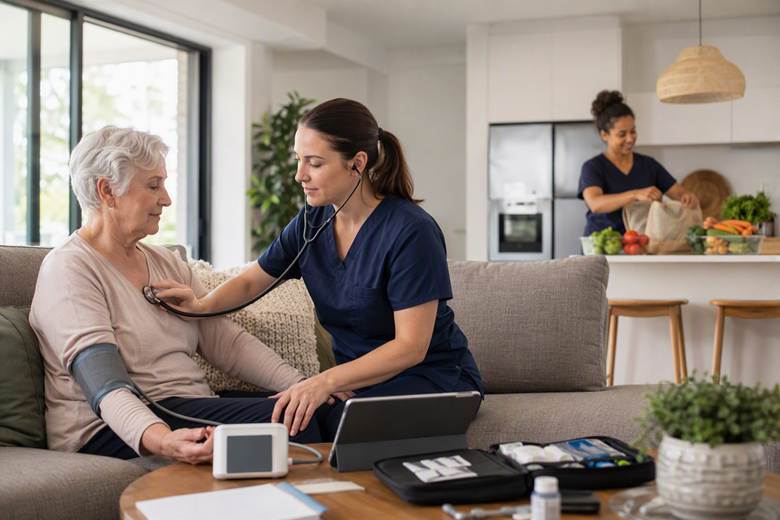
When someone you care about needs more help at home, it is easy to assume that all home care professionals perform roughly the same role. After all, both registered nurses and support workers can help a person remain comfortable, safe and independent in familiar surroundings.
But there is an important distinction.
A support worker is generally focused on assistance with everyday living and implementing agreed support plans. A registered nurse (RN), on the other hand, is a regulated health professional who can assess clinical needs, make nursing decisions and provide a range of clinical interventions within their scope of practice.
Understanding that difference can help you choose the right level of care, particularly when a person’s health needs become more complex.
This article explains where the roles overlap, what registered nurses can provide at home and when nursing expertise may be necessary.
Table of Contents
- The difference between a registered nurse and a support worker
- What can a registered nurse do at home?
- What does a support worker do?
- Where can the roles overlap?
- When might you need a registered nurse?
- Choosing the right level of home care
The Difference Between a Registered Nurse and a Support Worker
The simplest distinction is that registered nurses are regulated healthcare professionals.
In Australia, registered nurses must meet the professional standards and registration requirements of the Nursing and Midwifery Board of Australia. Their responsibilities can include assessing a person’s health, planning nursing care, delivering clinical interventions, monitoring outcomes and responding to changes in health.
Support workers have a different but equally practical purpose. They commonly assist people with everyday activities and help them follow established care or support plans.
For families comparing options such as in home nursing care Sydney services with general home support, the important question is therefore not simply who can help at home? It is what type of help does this person actually need?
Here is a simple comparison:
| Area of Care | Registered Nurse | Support Worker |
| Personal care | Can assist where appropriate | Commonly assists |
| Meal preparation and everyday tasks | May assist as part of broader care | Commonly assists |
| Clinical assessment | Yes, within nursing scope | No |
| Nursing care planning | Yes | Follows relevant support/care plans |
| Wound assessment and nursing management | Yes, within scope | May provide specified support when appropriately trained and permitted |
| Medication administration | Can administer within scope and applicable requirements | May provide medication-related assistance or certain supports depending on training, plan and requirements |
| Monitoring clinical conditions | Yes | Observes and reports changes |
| High-intensity supports | Can provide nursing care within scope | Some supports may be provided by appropriately trained workers under relevant plans and requirements |
The distinction matters because a person’s needs can move between everyday support and clinical care over time.
What Can a Registered Nurse Do at Home?
Home nursing brings clinical skills that you would normally associate with a healthcare setting into a person’s own home.
The Australian Government’s guidance for the Support at Home program identifies nursing services including wound care, continence management, assessment, treatment and monitoring of clinical conditions, medication administration and linkage with specialist services.
Depending on the person’s needs and the nurse’s scope of practice, an RN may provide:
- Health and nursing assessments
- Wound assessment, treatment and monitoring
- Medication administration and medication-related nursing support
- Continence assessment and management
- Monitoring of chronic health conditions
- Clinical observations and identification of changes in health
- Education for the person, family members and other carers
- Coordination with doctors, allied health professionals and other healthcare providers
This is where access to professional nursing support at home can become particularly relevant. If a person is recovering after hospital treatment, living with a chronic illness or experiencing changes in their health, clinical assessment can help determine what nursing care is appropriate rather than relying only on assistance with everyday activities.
An RN’s role is not simply to perform a medical task. Nursing involves assessment, clinical judgement, monitoring and evaluating how a person responds to care.
What Does a Support Worker Do?
Support workers can make an enormous difference to everyday independence.
Their work often focuses on helping a person complete daily activities that have become difficult because of age, disability, illness or reduced mobility. Depending on the individual’s support plan and the worker’s role, this might include:
- Showering and personal hygiene
- Dressing and grooming
- Preparing meals
- Household tasks
- Shopping
- Community access
- Companionship
- Mobility assistance
- Respite support
- Assistance with self-administration of medication where appropriate
Think of the difference this way: a support worker may help someone get ready for the day, prepare breakfast and safely complete their daily routine. An RN may assess why that same person has suddenly become dizzy, review relevant clinical observations and determine whether the change requires escalation or another healthcare professional.
Both roles contribute to safe care, but they approach the person’s needs from different professional perspectives.
Where Can the Roles Overlap?
This is where the distinction becomes less black and white.
It would be inaccurate to suggest that every health-related task can only ever be performed by a registered nurse. Under the NDIS, for example, appropriately trained support workers can provide certain high-intensity health-related supports when the necessary plans, training and safeguards are in place.
The NDIS Quality and Safeguards Commission lists high-intensity supports including:
- Complex bowel care
- Enteral feeding
- Dysphagia support
- Ventilation support
- Tracheostomy support
- Urinary catheter support
- Subcutaneous injections
- Complex wound support
The Commission explains that support workers delivering these services need appropriate skills and knowledge, and relevant training should be provided by an appropriately qualified health practitioner or another person who meets the applicable skills descriptor.
So the key difference is not always whether a support worker can physically perform a particular task.
Instead, consider who is qualified and authorised to assess the clinical situation, make nursing decisions, develop or review nursing care and determine how changes in a person’s condition should be managed.
A trained support worker may implement parts of an established plan and report concerns. A registered nurse brings professional nursing assessment and clinical decision-making to that care.
When Might You Need a Registered Nurse?
Needing help at home does not automatically mean you need an RN. If your main concerns are meal preparation, showering, household tasks or companionship, a support worker may provide the appropriate level of assistance.
Nursing care becomes more relevant when health needs require clinical assessment, monitoring or treatment.
For example, you may need to discuss nursing support if a person:
- Has a wound requiring nursing assessment or treatment
- Needs clinical monitoring after leaving hospital
- Has a chronic condition requiring ongoing nursing management
- Requires medication administration that falls within nursing care
- Develops unexplained or significant changes in their health
- Requires continence assessment or clinical management
- Has complex health needs alongside their everyday support needs
- Requires education about managing a health condition at home
Sometimes the answer is not choosing one role over the other.
A person may benefit from a support worker for everyday activities and an RN for specific clinical needs. This combination can allow each professional to focus on the work that best matches their skills and responsibilities.
Choosing the Right Level of Home Care
Start with the person’s needs rather than a job title.
Ask what assistance is required today and what risks or health conditions need to be considered. It can also help to think about whether those needs are stable or changing.
Questions worth asking include:
- Does the person mainly need help with everyday activities?
- Is there a health condition requiring regular clinical monitoring?
- Are there wounds, medications or other treatments that need professional nursing input?
- Has the person’s condition recently changed?
- Is there a clear plan explaining which tasks can be performed by trained support workers?
- Who is responsible for assessing and reviewing clinical needs?
- What happens if the person’s health deteriorates?
The Australian Government separates home aged care services into areas including clinical supports, independence services and everyday living services. That distinction reflects an important reality: living safely at home can involve several different types of assistance rather than a single kind of care.
Getting the Right Care at the Right Time
Registered nurses and support workers are not interchangeable, but neither role should be viewed as more valuable than the other.
Support workers can provide the practical, consistent assistance that helps people participate in daily life and remain independent. Registered nurses provide regulated nursing expertise when a person’s needs involve clinical assessment, nursing judgement, treatment or monitoring.
The right approach depends on the individual.
When health needs are simple and stable, everyday support may be enough. When those needs become clinical, complex or change unexpectedly, nursing expertise can add an important layer of assessment and care. For many people, the most effective arrangement is a coordinated combination of both.
Understanding where each role begins and ends helps you ask better questions, build a safer care plan and make sure the person receives the right type of support at the right time.